
The chart spiked before the coffee cooled. Lumentum’s sales had more than doubled—a clean, violent number that screamed "AI demand" at the market. But the real story wasn’t in the revenue line. It was in the whisper that followed: supply chain constraints are tightening. And if you’re building anything in crypto that depends on high-speed data centers—mining, validation, decentralized AI—you just hit a new ceiling. Not a chip ceiling. A glass one.
I’ve been watching this space since the ICO fog of 2017, when I sprinted through whitepapers for Golem and Status, chasing the green candle before the crowd even smelled the fire. Back then, the bottleneck was GPU supply. Miners fought over every card. In DeFi Summer, it was gas fees. In the NFT mania, it was Ethereum block space. Each time, the market underestimated the physical layer. Now, the bottleneck is optical. And Lumentum’s sales spike is the canary in the coal mine.
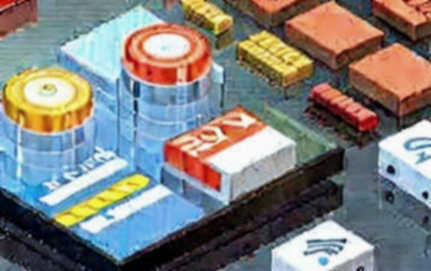
Lumentum makes laser diodes, optical modules, and the tiny glass components that connect GPUs across data centers. Without them, a thousand H100s are just a pile of expensive silicon. AI training clusters need 800G interconnects today, and the industry is already pushing toward 1.6T. Every GPU needs a fiber link. Every link needs a laser chip. And those chips take 18 to 24 months to ramp production. That’s a lag that the market hasn’t priced in.
Context: Why This Matters for Crypto
Crypto infrastructure is no longer just about hashing or staking. It’s about compute. Projects like Render Network, Akash, and Bittensor are turning GPUs into a decentralized resource. AI inference is being auctioned on-chain. Validators for layer-2 rollups rely on high-bandwidth sequencing. Even Bitcoin mining operations are upgrading to fiber-optic networking to improve efficiency. The underlying assumption is that network bandwidth will scale as needed. But optical components are not software—they are physical devices made in fabs with long lead times.
Lumentum’s double-digit growth is a leading indicator that the AI demand is real, but the supply response is too slow. I saw this pattern in 2017 when ICOs raised millions for projects that had no infrastructure to deliver. The hype outpaced the hardware. Now, the same thing is happening with AI-crypto crossover. The difference is that the bottleneck is not just GPUs—it’s the optical interconnects that tie them together.
Core: The Wooden Bucket of AI Infrastructure
Let’s dig into the numbers. The analysis report—based on limited public data—confirms the core fact: Lumentum’s sales more than doubled. That’s a reliable signal. But the real insight is in the supply chain structure. Optical modules are a multi-layer system: laser chips (VCSELs, EMLs, silicon photonics), DSPs (digital signal processors), ceramic packaging, and fiber connectors. Each layer has its own capacity constraints. The DSPs are made by a handful of companies (Broadcom, Marvell). The laser chips require specialized epitaxy. The packaging is manual-intensive.
During the 2021 NFT mania, I attended NFT.NYC and saw how the hype around Bored Apes outpaced the Ethereum network’s capacity. The same thing is happening now, but at the physical layer. Data center operators are placing orders for 800G optical modules that are already backordered. Lead times are stretching from 8 weeks to 20 weeks. Prices are rising. And the bottleneck is self-reinforcing: as demand surges, manufacturers rush to build new capacity, but the capital expenditure cycle takes years.
From my experience in the 2022 bear market, I learned to watch for the human signals. The sentiment shift. When I organized crypto meetups in Ho Chi Minh City, I saw developers building despite the crash. Now, I’m seeing procurement managers at mining farms scrambling for optical components. They tell me the same thing: "We can get the GPUs, but we can’t get the cables." That’s the wooden bucket—the weakest link determines the throughput.
Contrarian: The Unreported Angle
Everyone is watching NVIDIA’s earnings. But the smart money whispers: the optical bottleneck is the new gas limit. Here’s the contrarian take: AI demand is not purely beneficial for crypto. It may actually crowd out crypto infrastructure. Cloud providers like AWS, Google, and Azure are buying up optical capacity for their own AI workloads. That leaves less for decentralized compute networks. The narrative that "AI will save crypto" is oversimplified. In reality, the tension between centralized AI and decentralized AI is playing out in the supply chain for optical modules.
Another blind spot: export controls. Lumentum is a U.S. company. Its lasers and optical components fall under ITAR and EAR regulations. If the U.S. tightens restrictions on advanced optical components to China, it could disrupt the supply chain for Chinese miners and crypto projects that rely on Asian manufacturing. This is a geopolitical risk that most crypto analysts ignore. I’ve been tracking this since the 2022 crash, when the human side of the market became the story. Now, the security side is becoming the market mover.
Takeaway: What to Watch Next
Speed is the only currency that matters now—but only if the glass can carry it. The next 6 to 12 months will be a scramble for optical capacity. I’m watching for Lumentum’s next earnings report for gross margin and order backlog. I’m also tracking lead times from LightCounting’s monthly data. If the bottleneck persists, crypto projects that depend on high-bandwidth networking—DePIN, decentralized AI, high-frequency trading on exchanges—will face delays. The contrarian play: projects that optimize for lower bandwidth, or that use alternative networking like wireless or satellite, could gain a temporary edge.
Digital gold rushes turn pixels into portfolios. But the gold is useless if the carts can’t carry it. The optical bottleneck is the cart. And right now, the cart is stuck in a traffic jam of laser chips and DSPs. Ride the wave before it crashes back—but keep your eyes on the glass.